
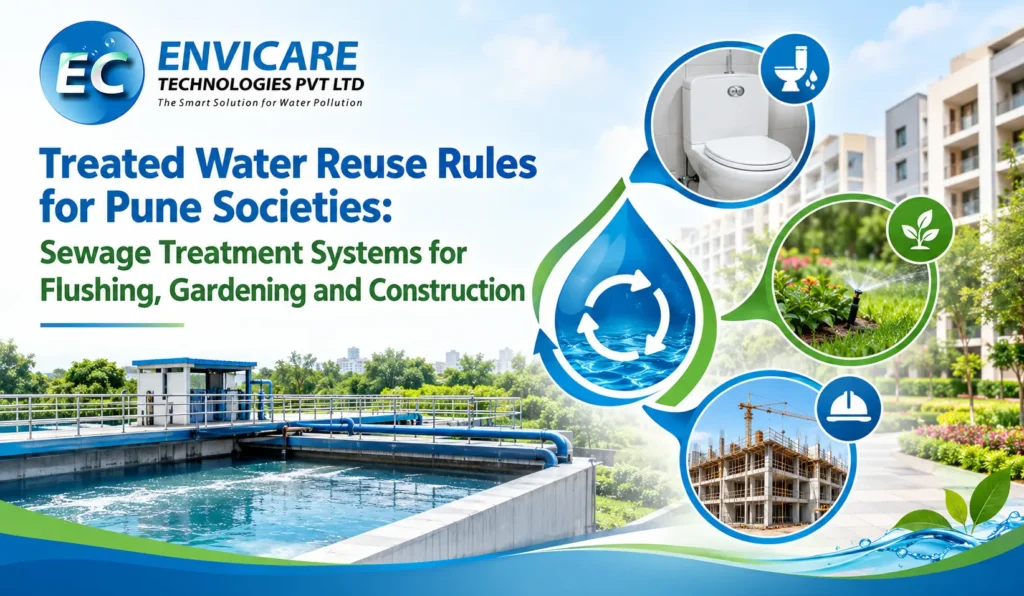
Pune’s growing water demand has brought renewed attention to wastewater recycling in residential complexes.Housing societies are being urged to conserve freshwater, ensure the efficient operation of their sewage treatment plants, and reuse treated wastewater for appropriate non-potable applications. . Recent water-management measures in Pimpri-Chinchwad have further highlighted the importance of using treated sewage for gardening and other non-potable applications. Source: The Indian Express.
For housing societies, the issue is no longer limited to installing a sewage treatment plant (STP). The bigger challenge is ensuring that the plant operates efficiently, the treated water meets the requirements for its intended use, and the reuse system complies with applicable local conditions.
From toilet flushing and landscaping to selected construction activities, treated wastewater can support better water management when handled correctly. However, societies must understand the difference between treated water that is suitable for a particular application and water that is safe for drinking.
This guide explains the important considerations surrounding treated water reuse in Pune and Pimpri-Chinchwad, including applicable rules, practical applications, safety precautions and the responsibilities of housing society management committees.
Why Treated Water Reuse Is Becoming Important in Pune
Residential complexes generate substantial quantities of wastewater every day through bathrooms, kitchens, washbasins and other domestic activities. Instead of treating this wastewater as something that must simply be disposed of, societies can recover part of the water for appropriate secondary uses.
Efficient sewage treatment systems help reduce the demand for freshwater by treating sewage generated within a property. Depending on the treatment process and final water quality, the treated output can be considered for toilet flushing, gardening and other suitable non-potable applications.
For societies that rely on municipal supplies or water tankers, this approach can be particularly valuable during periods of restricted supply. Reusing treated water can reduce the quantity of fresh water required for routine activities and improve the utilisation of an existing STP.
However, installing treatment equipment alone does not guarantee water savings. The plant must be operated correctly, the treated water must be distributed through a suitable system, and the society must identify applications that can consistently use the available volume.
What Are the Treated Water Reuse Rules for Pune Societies?
Housing societies in Pune and PCMC should review the requirements applicable to their individual properties rather than assume that one regulation covers every residential building.
Relevant requirements may arise from municipal building approvals, environmental clearances, Maharashtra Pollution Control Board (MPCB) consent conditions and directions issued by the local authority. These may specify STP installation, treatment performance, water-quality monitoring, recycling arrangements and the management of surplus treated water.
MPCB consent records for residential developments in Maharashtra include conditions requiring substantial reuse of treated domestic effluent for secondary purposes, such as toilet flushing, with remaining water directed to approved uses or disposal arrangements. The exact conditions vary by project and approval. Source: MPCB consent records.
Societies should therefore verify the specific conditions attached to their project instead of treating a percentage or technical standard from another building’s consent as a universal requirement.
The important principle is that wastewater must be treated appropriately, reused safely and managed in accordance with the conditions applicable to the property. Discharging untreated sewage into stormwater drains or allowing an STP to remain non-functional can create environmental and compliance problems.
Can Treated Water Be Used for Toilet Flushing?
Toilet flushing is one of the most practical uses of treated sewage in residential buildings. Unlike drinking water, flushing water does not generally require potable quality. Nevertheless, it must meet the relevant requirements for its intended use and be distributed through a safe plumbing arrangement.
A properly designed wastewater treatment system can produce water suitable for flushing when the treatment process, filtration and disinfection arrangements are appropriate and the required water-quality parameters are achieved.
The plumbing infrastructure is equally important. Treated water should be carried through a separate, clearly identified distribution network that prevents accidental connections with drinking-water pipelines. Storage tanks, valves, pumps and flushing connections should be inspected regularly.
If a plant develops a treatment problem, the society should investigate the cause rather than assume the water remains suitable because the pumps are running. Persistent odour, unusual colour or visible suspended matter may indicate that the treatment process needs attention.
Societies planning to introduce treated-water flushing into an existing building should obtain a professional assessment of the plumbing layout and available STP capacity before making modifications.
Treated Water for Gardening and Landscaping
Gardening is another important application for reclaimed water. Residential complexes often maintain lawns, trees, ornamental plants and landscaped common areas that require regular irrigation.
Using appropriately treated wastewater for these activities can reduce the consumption of potable water. It may also help societies manage landscaping requirements during periods when freshwater supplies are limited.
However, treated water should be tested to ensure it meets the required quality standards before being reused. Dissolved salts, nutrients, microorganisms and residual pollutants can affect plant health, soil conditions and the safety of people using common areas.
The irrigation method also matters. Controlled watering methods can reduce unnecessary contact, runoff and aerosol formation. Areas frequently used by children, residents and maintenance staff require particular attention.
Societies should ensure that garden workers understand the water source and that treated-water outlets and storage tanks are clearly labelled. Drinking, cooking and other potable uses should never be assumed to be acceptable simply because the water appears clear.
Regular testing and appropriate STP maintenance help ensure that the quality of the treated water remains suitable for the intended irrigation application.
Can Treated Water Be Used for Construction?
Construction and maintenance work may create additional opportunities to reuse treated wastewater. Housing societies undertaking redevelopment, civil repairs, landscaping improvements or building maintenance may need water for selected activities.
Depending on the water quality and technical specifications, treated wastewater may be considered for dust suppression, site cleaning and certain curing operations. Each application must be assessed individually.
For concrete and other construction materials, the contractor or responsible engineer should verify that the water meets the relevant engineering specifications and applicable standards. Unsuitable water can affect construction quality, so its use should never be approved solely because it has passed through an STP.
Dust suppression requires separate precautions.Water must be used carefully and in a controlled way to reduce direct exposure, prevent unnecessary runoff and limit the formation of water droplets in the air. . Site teams should also prevent contaminated water from entering drinking-water sources or nearby drainage systems.
Before using treated water at a construction site, the society should coordinate with its STP operator and contractor to establish the required water quality, available quantity, storage arrangements and approved method of use.
Which Applications Are Suitable for Treated Water?
The following table provides a practical overview. Final suitability depends on water quality, applicable rules, project approvals and technical requirements.
| Application | Key requirement | Recommended precaution |
| Toilet flushing | Appropriate treatment and disinfection | Maintain separate non-potable plumbing |
| Gardening and lawns | Suitable water quality for irrigation | Assess salinity, microbial quality and exposure |
| Construction curing | Compliance with engineering specifications | Obtain approval from the responsible engineer |
| Dust suppression | Appropriate quality and controlled application | Minimise exposure, aerosols and runoff |
| Common-area cleaning | Suitability for the cleaning task | Prevent unintended contact and cross-connections |
The central consideration is not simply whether treated water is available. It is whether the water is appropriate for the proposed use and can be supplied consistently without creating health, environmental or operational risks.
Choosing the Right STP for a Housing Society
Selecting the appropriate plant is essential for achieving reliable treatment and reuse. A small sewage treatment plant may be suitable for a smaller residential development, while a large housing society may require a system designed for higher sewage volumes and variable daily loading.
The design should consider the number of residents, expected sewage generation, available space, treatment objectives and future changes in occupancy. A plant that is undersized or poorly matched to the actual wastewater load may struggle to produce consistent treated-water quality.
Housing societies should also consider the ease of operation, maintenance requirements, availability of spare parts and energy consumption. The most appropriate solution is not necessarily the plant with the lowest initial installation cost; long-term operating reliability is equally important.
For an individual villa or small residential property, a home sewage treatment plant may be considered where technically appropriate and permitted. Larger developments generally need a more comprehensive assessment based on combined wastewater generation and applicable approval requirements.
Existing societies should assess their current plant before deciding whether replacement, repair or upgrading is necessary.
What Should Society Management Committees Do?
The managing committee is responsible for ensuring that the society’s wastewater management arrangements receive proper oversight. Even when an external contractor operates the plant, the society should understand its performance and applicable compliance obligations.
A plant may appear operational while producing water that does not meet the required standards. Consequently, committees should review water-quality results and maintenance records rather than rely exclusively on visual inspections.
Four practical priorities can improve management:
- Routine maintenance: Inspect pumps, blowers, dosing equipment, tanks and other essential components.
- Water-quality testing: Follow the testing schedule and parameters required by applicable conditions and intended reuse.
- Documentation: Keep detailed records of maintenance activities, water quality test results, equipment failures and the corrective measures taken.
- Safe water distribution: Keep potable and treated-water networks separate, clearly labelled and properly maintained.
The society should also establish a contingency plan for equipment failure, poor treatment results or interruptions in treated-water production. Reuse should not continue as normal when the water’s suitability is uncertain.
Warning Signs That an STP Needs Attention
When an STP shows a decline in treatment efficiency, the underlying issues should be identified and addressed without delay. Common warning signs include persistent foul odour, unusual water colour, excessive foam, visible solids, recurring equipment failures and complaints about flushing or irrigation water.
These symptoms can have different causes, including inadequate aeration, excessive loading, poor sludge management, equipment breakdown or problems with disinfection.
Simply adding more chemicals may not solve the underlying problem.A qualified operator or wastewater-treatment specialist should evaluate the treatment system and use suitable sampling and testing methods to identify the necessary improvements.
A reliable sewage water treatment process depends on the complete treatment sequence, correct operation and regular monitoring. Preventive maintenance can help reduce breakdowns, improve consistency and support the safe reuse of treated water.
How Envicare Technologies Supports Treated Water Reuse
Envicare Technologies Pvt. Ltd., based in Pune, provides water and wastewater-treatment solutions, including STP and ETP systems, repair, upgrading and operation and maintenance support.
For housing societies planning to reuse treated wastewater, a technical assessment can help determine whether the existing plant is performing correctly and whether its output is suitable for the proposed application. Depending on the property, this may involve reviewing treatment capacity, mechanical and electrical equipment, process performance, water-quality reports and reuse infrastructure.
The right solution depends on the site’s needs, the plant’s condition and the requirements applicable to the property. Societies should assess these factors before making major changes to their treatment or plumbing systems.
Learn more about Envicare’s solutions at https://envicare.co.in/.
Conclusion
Treated water reuse is an important opportunity for Pune housing societies seeking to reduce freshwater consumption and improve wastewater management. Toilet flushing, landscaping and selected construction activities can benefit from reclaimed water when the quality, infrastructure and applicable requirements support those uses.
Successful reuse depends on more than installing an STP. Societies must ensure proper plant operation, appropriate water-quality testing, safe plumbing, responsible storage and regular maintenance.
By understanding their approval conditions and matching treated-water quality to its intended application, housing societies can make better decisions about water conservation and environmental responsibility.