
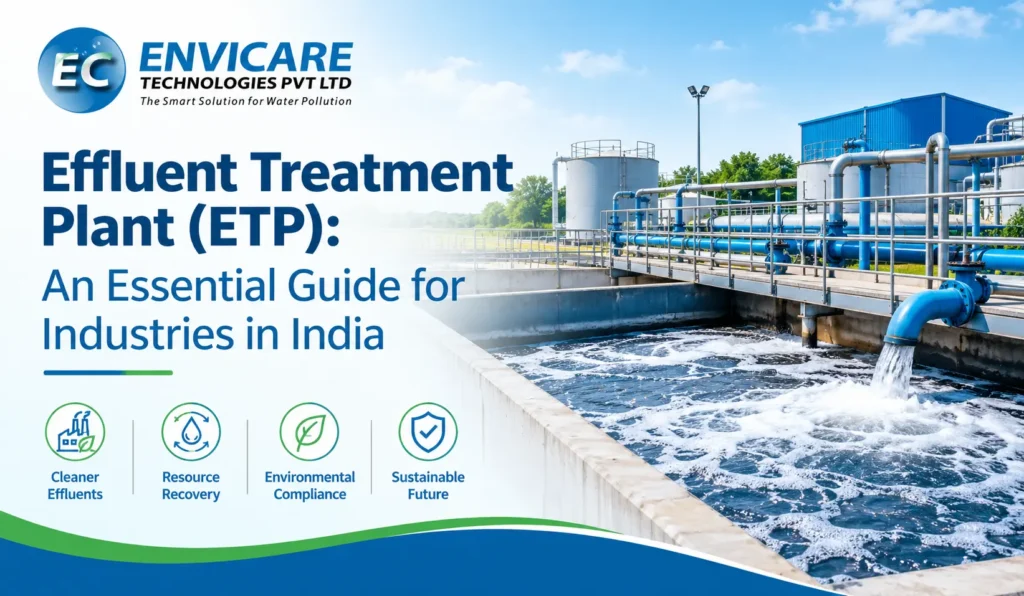
India’s manufacturing sector is expanding across chemicals, pharmaceuticals, textiles, food processing, engineering, metal finishing and other industrial segments. Alongside this growth, the responsible management of industrial wastewater has become an important operational and environmental priority. Effluent generated during manufacturing can contain chemicals, oils, suspended solids, dyes, heavy metals and organic pollutants that may harm water bodies and soil if released without appropriate treatment.
An Effluent Treatment Plant (ETP) helps industries manage this wastewater by reducing contaminants before the treated water is discharged through an authorised outlet or reused for suitable applications. For Indian businesses, an ETP is not simply a wastewater management installation.It plays a vital role in meeting environmental regulations, conserving resources, and supporting long-term operational efficiency.
This guide explains how an ETP works, which industries may need one, the treatment technologies involved, the factors affecting its cost and the maintenance practices that support reliable performance.
What Is an Effluent Treatment Plant?
An Effluent Treatment Plant (ETP) is a specially designed system that processes wastewater produced during industrial operations. It aims to remove contaminants and bring the treated water within the quality limits required for safe discharge or reuse.
Industrial wastewater differs significantly from domestic sewage. Water from a textile dyeing unit may contain colour, salts and organic chemicals, while wastewater from a metal finishing facility may contain oils, acids, alkalis and dissolved metals. Pharmaceutical and chemical manufacturing can generate complex wastewater streams with varying concentrations of organic and inorganic pollutants.
Because these contaminants differ from one industry to another, an ETP must be designed around the actual wastewater characteristics of the facility. A standard treatment arrangement may not deliver satisfactory results when the wastewater contains unusual chemicals, fluctuating pH or high concentrations of dissolved solids.
An effective ETP design therefore begins with understanding the wastewater quantity, its composition, production schedules, discharge requirements and opportunities for water recovery.
Why Do Indian Industries Need an ETP?
Industrial wastewater management is closely connected with environmental protection and regulatory compliance. Under India’s environmental framework, industrial units must meet the applicable discharge conditions and requirements imposed by the relevant pollution control authority. Depending on the industry and location, this may involve the Central Pollution Control Board (CPCB), the State Pollution Control Board (SPCB) or another competent authority.
The Maharashtra Pollution Control Board (MPCB), for example, provides information on environmental standards and ETP operation and maintenance guidelines for industries operating in Maharashtra.
The applicable requirements can vary according to the industry, wastewater composition, receiving environment, authorised disposal route and conditions specified in the unit’s Consent to Establish or Consent to Operate. Industries should therefore verify the standards applicable to their particular operations instead of relying on a single universal discharge limit.
Beyond compliance, wastewater treatment can help companies reduce freshwater consumption, improve process-water management and minimise the environmental risks associated with untreated effluent. If the treated water satisfies the required quality standards, it can be reused for suitable non-drinking applications, depending on its intended use.
How Does an Effluent Treatment Plant Work?
An ETP typically combines physical, chemical, and biological methods to treat industrial wastewater. The selection and order of these processes depend on the type of contaminants in the wastewater and the desired quality of the treated effluent.
1. Preliminary Treatment and Screening
The first stage removes larger particles, floating materials and debris that could damage pumps or interfere with downstream equipment. Screening and, where necessary, grit or oil removal help protect the treatment system.
This stage is particularly important for industries that generate wastewater containing fibres, food particles, metal fragments or other process-related solids.
2. Equalisation and pH Correction
Industrial wastewater quality can change throughout the day as production activities vary. An equalisation tank collects and mixes incoming wastewater to reduce sudden changes in flow and pollutant concentration.
The wastewater’s pH is adjusted by adding appropriate chemicals to achieve the required range for the next stages of treatment. This helps improve the performance of chemical reactions and biological processes.
Without effective equalisation and pH control, sudden changes in wastewater characteristics may affect treatment efficiency and cause operational instability.
3. Primary Chemical Treatment
Chemical treatment helps eliminate contaminants through chemical reactions, settling, or separation. Based on the wastewater characteristics, methods such as coagulation, flocculation, pH neutralisation, and chemical precipitation may be applied.
Coagulants and flocculants help smaller suspended particles combine into larger flocs, which can then be separated by settling or flotation. Certain dissolved metals can also be removed through precipitation under appropriately controlled conditions.
The chemicals, dosage and operating conditions must be selected according to wastewater analysis and treatment objectives.
4. Secondary Biological Treatment
Biological treatment uses microorganisms to break down biodegradable organic pollutants. Common systems include activated sludge processes, moving bed biofilm reactor (MBBR) systems and other biological configurations selected according to the wastewater characteristics.
Aeration supplies oxygen where required, allowing microorganisms to carry out biological degradation. A downstream clarifier or another suitable separation system then separates biological solids from the treated water.
Biological treatment is not suitable for every contaminant. Wastewater containing toxic substances, excessive salinity or poorly biodegradable compounds may require pretreatment or specialised treatment before biological processes can operate effectively.
5. Tertiary Treatment and Water Recovery
Tertiary treatment improves the quality of water after the main treatment stages. Depending on the required outlet quality, this may involve pressure sand filtration, activated carbon filtration, membrane filtration, disinfection or other specialised processes.
Where industries aim to reuse water, additional technologies such as ultrafiltration (UF), reverse osmosis (RO) or evaporation systems may be considered. Their suitability depends on the dissolved contaminants, recovery target, energy consumption and concentrate-management requirements.
Zero Liquid Discharge (ZLD) systems are designed to prevent routine liquid effluent discharge from the defined process boundary. However, achieving ZLD can require significant energy, specialised equipment and careful management of concentrated residues.
Which Industries Require Effluent Treatment?
The need for an ETP depends on the wastewater generated and the conditions applicable to the industrial unit. Industries with process wastewater should assess treatment requirements during plant planning, expansion and environmental compliance reviews.
Common sectors include:
- Chemical and pharmaceutical industries: Wastewater may contain solvents, organic compounds, acids, alkalis and process chemicals.
- Textile and dyeing units: Effluent can contain colour, dyes, salts, suspended solids and high organic loads.
- Food and beverage processing: Wastewater may contain fats, oils, grease, sugars, proteins and biodegradable organic matter.
- Metal finishing and engineering: Pickling, plating and surface-treatment processes can generate acidic or alkaline wastewater containing oils and metals.
- Automotive and manufacturing facilities: Process cleaning, washing and surface preparation may generate contaminated water requiring dedicated treatment.
- Paper, pulp and other process industries: Wastewater characteristics vary according to raw materials, production methods and chemical use.
Some industrial estates operate a Common Effluent Treatment Plant (CETP), where wastewater from participating units is treated at a shared facility. The suitability of this arrangement depends on the cluster’s infrastructure, the type of effluent generated and the applicable acceptance conditions. Industries must confirm whether their wastewater can be accepted by the relevant CETP and what pretreatment or monitoring obligations apply.
ETP Technologies: Which System Is Suitable?
No single ETP technology is ideal for every industry. Selecting the right treatment configuration requires an assessment of wastewater quality, treatment targets, available space, operating costs and future production requirements.
| Treatment technology | Primary application | Important consideration |
| Chemical treatment | pH correction, suspended solids and certain metals | Chemical dosage and sludge generation |
| Activated sludge process | Biodegradable organic pollutants | Aeration, sludge control and biological stability |
| MBBR | Biological treatment using attached-growth media | Media retention, aeration and hydraulic design |
| Membrane-based treatment | Fine solids separation and advanced water recovery | Membrane fouling, cleaning and replacement |
| Reverse osmosis (RO) | Reduction of dissolved salts and selected contaminants | Pretreatment, energy use and reject management |
| Evaporation-based systems | Concentration of wastewater for high-recovery or ZLD applications | High energy demand and residue handling |
A combination of technologies is often more effective than relying on a single process. For example, a facility may use chemical treatment to remove metals and suspended solids before biological treatment, followed by filtration and RO where water reuse is required.
Factors That Determine ETP Plant Cost in India
The cost of an ETP cannot be estimated accurately from capacity alone. Two plants treating the same volume of wastewater may require substantially different equipment because their pollutant loads, treatment targets and operating conditions differ.
The first major factor is wastewater flow, commonly expressed in kilolitres per day (KLD). However, pollutant concentration is equally important. A relatively small volume of highly contaminated chemical effluent may require more complex treatment than a larger volume of comparatively dilute wastewater.
Technology selection also affects capital expenditure. Chemical dosing systems, biological reactors, clarifiers, filters, membranes, automation, pumps and sludge-handling equipment contribute differently to the total project cost. Additional civil works, electrical installations, piping, instrumentation and site modifications can further influence the budget.
Operating expenses must also be considered. Electricity, treatment chemicals, skilled operators, laboratory testing, equipment maintenance and sludge disposal contribute to the overall cost of ownership. Membrane-based and evaporation-based systems may introduce additional energy and maintenance requirements.
For this reason, industries should compare proposals on the basis of treatment performance, lifecycle cost, water recovery and compliance suitability rather than choosing a plant solely because its initial price is lower.
ETP Compliance and Monitoring in India
An ETP must be designed and operated according to the environmental requirements applicable to the particular industrial unit. General discharge standards under the Environment (Protection) Rules, 1986, and industry-specific requirements may apply alongside conditions imposed by the relevant pollution control authority.
Parameters such as pH, biochemical oxygen demand (BOD), chemical oxygen demand (COD), total suspended solids (TSS), oil and grease, dissolved solids and specific chemical contaminants may need to be monitored according to the wastewater type and applicable standards.
Maintaining reliable records is equally important. Industries should retain relevant laboratory reports, operating logs, chemical consumption records, sludge disposal documentation and equipment maintenance records as required by their permits and applicable regulations.
Compliance should not depend only on occasional sampling. Regular monitoring helps operators identify treatment problems early and take corrective action before outlet quality deteriorates.
How to Improve ETP Performance and Reduce Operating Costs
A well-designed plant can still perform poorly if it is not operated correctly. In many facilities, avoidable expenditure results from excessive chemical dosing, inefficient aeration, equipment deterioration, inconsistent wastewater inflow and delayed maintenance.
Industries can improve ETP performance through four practical measures:
- Monitor wastewater at the source: Identify process streams with high pollutant loads and segregate them where technically appropriate.
- Optimise chemical consumption: Use wastewater testing and controlled dosing rather than applying chemicals without measuring treatment requirements.
- Maintain mechanical and biological systems: Inspect pumps, blowers, mixers, dosing equipment and treatment tanks according to a planned maintenance schedule.
- Track performance data: Record flow, pH, energy consumption, chemical usage and outlet quality to identify deviations and improvement opportunities.
Water reuse should also be evaluated wherever technically and economically suitable. Reusing treated water for approved applications can reduce freshwater demand, although the required quality must be verified for each intended use.
Common ETP Problems Faced by Industries
ETP performance can decline because of both design limitations and operational issues. Sudden changes in influent quality may disturb biological treatment, while incorrect chemical dosing can increase sludge production or leave pollutants insufficiently treated. Poor aeration, blocked pipelines, damaged pumps and inadequate sludge management can also affect the final outlet quality.
In some cases, an existing plant was designed for an earlier production capacity and can no longer handle the current wastewater load. Adding production lines without reassessing the treatment system may lead to hydraulic overloading or insufficient pollutant-removal capacity.
When an ETP consistently fails to meet its treatment targets, the appropriate response is to investigate the root cause. A technical assessment may include wastewater sampling, hydraulic evaluation, equipment inspection, process review and an analysis of operating records. Depending on the findings, corrective action may involve process optimisation, equipment replacement, capacity augmentation or complete plant upgradation.
Maintenance: The Key to Long-Term ETP Reliability
Preventive maintenance helps reduce unexpected breakdowns and supports consistent treatment quality. Operators should routinely inspect pumps, blowers, motors, dosing systems, valves, filters and instrumentation. Biological systems also require attention to aeration, sludge characteristics and process stability.
Periodic laboratory testing should verify that the treatment process continues to achieve the required outlet quality. Maintenance plans should be based on equipment manuals, operating conditions, manufacturer recommendations and the plant’s actual performance data.
Industries that lack in-house technical expertise may consider professional operation and maintenance (O&M) support. A structured maintenance programme can help identify developing faults, improve equipment reliability and reduce the risk of prolonged treatment failures.
Conclusion
An Effluent Treatment Plant is an important component of responsible industrial wastewater management in India. Its effectiveness depends on more than installing treatment equipment: the system must match the wastewater characteristics, meet applicable environmental requirements and remain properly maintained throughout its operating life.
By selecting suitable technology, monitoring wastewater quality, controlling operating expenses and planning for water reuse where feasible, industries can improve ETP reliability while supporting environmental protection.
Envicare Technologies provides water and wastewater treatment solutions for industrial applications, including ETP design, installation, repair, upgradation and operation and maintenance support. Industries evaluating a new treatment plant or an existing system can begin with a technical assessment of their wastewater characteristics, treatment objectives and site requirements.