
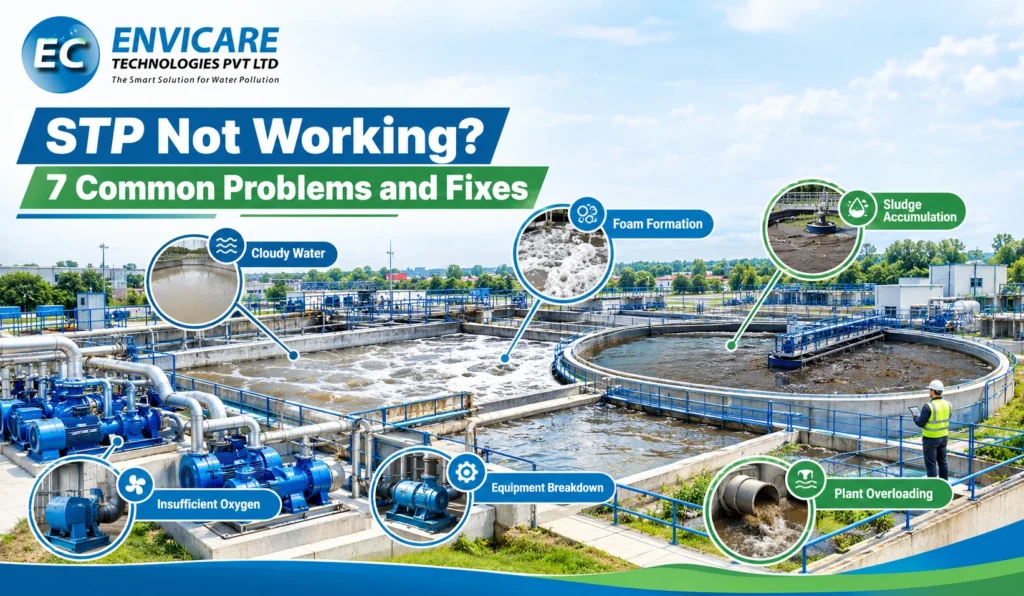
STP Not Working? 7 Common Problems and Fixes A Sewage Treatment Plant (STP) plays an important role in managing wastewater generated by residential societies, commercial buildings, hotels, hospitals, and industrial facilities. A properly functioning STP treats sewage and converts it into treated water that can be reused for gardening, flushing, cooling towers, and other suitable
Effluent Treatment Plant Process & Flow Diagram: Stages Explained Industrial wastewater management has become an important part of modern manufacturing and industrial development. Industries such as pharmaceuticals, chemicals, textiles, food processing, automobiles, and engineering generate wastewater containing different types of pollutants. If this wastewater is released without proper treatment, it can negatively affect rivers, groundwater,
Sewage Treatment Plant Process & Flow Diagram Explained
Sewage treatment has become an essential part of modern infrastructure as residential societies, commercial buildings, hospitals, hotels and industrial facilities generate wastewater every day. If this wastewater is released without appropriate treatment, it can pollute rivers, contaminate soil and groundwater, and create serious environmental and public health concerns. A Sewage Treatment Plant (STP) is designed
Sewage Treatment Plant Process & Flow Diagram Explained Read More »
Types of Sewage Treatment Plant: ASP, MBBR, SBR and MBR Compared
Sewage treatment has become an important part of building infrastructure in India as residential societies, commercial complexes, hotels, hospitals and industrial facilities look for reliable ways to manage wastewater. As the need to conserve freshwater grows, treated wastewater can be reused for purposes like toilet flushing, landscape irrigation and other non-drinking applications where water quality
Types of Sewage Treatment Plant: ASP, MBBR, SBR and MBR Compared Read More »
Sewage Treatment Plant (STP): A Practical Guide for Housing Societies, Hotels and Hospitals in India
Managing wastewater has become an important part of operating residential and commercial properties in India. Housing societies, hotels and hospitals generate wastewater daily through bathing, washing, kitchen activities, laundry and other routine operations. Handling this wastewater properly requires a suitable treatment system that can manage the incoming flow and produce water that meets the intended
Effluent Treatment Plant (ETP): An Essential Guide for Industries in India
India’s manufacturing sector is expanding across chemicals, pharmaceuticals, textiles, food processing, engineering, metal finishing and other industrial segments. Alongside this growth, the responsible management of industrial wastewater has become an important operational and environmental priority. Effluent generated during manufacturing can contain chemicals, oils, suspended solids, dyes, heavy metals and organic pollutants that may harm water
Effluent Treatment Plant (ETP): An Essential Guide for Industries in India Read More »
ETP Plant Cost in India: What Decides the Price for Your Industry?
India’s growing industrial sector is placing greater emphasis on wastewater management, pollution control and water reuse. From pharmaceutical and chemical manufacturing units to textile processing plants, food industries and engineering facilities, businesses increasingly need reliable systems to treat industrial effluent before discharge or reuse. As a result, understanding the ETP plant cost in India has
ETP Plant Cost in India: What Decides the Price for Your Industry? Read More »
Treated Water Reuse Rules for Pune Societies: Sewage Treatment Systems for Flushing, Gardening and Construction
Pune’s growing water demand has brought renewed attention to wastewater recycling in residential complexes.Housing societies are being urged to conserve freshwater, ensure the efficient operation of their sewage treatment plants, and reuse treated wastewater for appropriate non-potable applications. . Recent water-management measures in Pimpri-Chinchwad have further highlighted the importance of using treated sewage for gardening
STP Plant Cost in India 2026: Cost per KLD by Technology
The cost of installing a sewage treatment plant (STP) in India in 2026 depends on several factors, including treatment capacity, technology, civil construction, automation and the quality of treated water required. For builders, housing societies, hotels, hospitals and commercial developers, understanding these costs before starting a project can help prevent budget overruns and operational problems.
STP Plant Cost in India 2026: Cost per KLD by Technology Read More »
STP Capacity Calculator: How Many KLD Does Your Society Need?
Choosing the right sewage treatment plant capacity is one of the most important decisions for a housing society, residential complex, or apartment project. A plant with insufficient capacity may struggle to treat daily wastewater, while an oversized system can increase installation costs, electricity consumption, and maintenance expenses. Understanding how much sewage your society generates is
STP Capacity Calculator: How Many KLD Does Your Society Need? Read More »
