
Sewage treatment has become an important part of building infrastructure in India as residential societies, commercial complexes, hotels, hospitals and industrial facilities look for reliable ways to manage wastewater. As the need to conserve freshwater grows, treated wastewater can be reused for purposes like toilet flushing, landscape irrigation and other non-drinking applications where water quality standards permit.
However, choosing a sewage treatment plant (STP) involves more than deciding its treatment capacity. The technology used inside the plant affects its space requirements, installation cost, electricity consumption, maintenance needs and treated water quality.
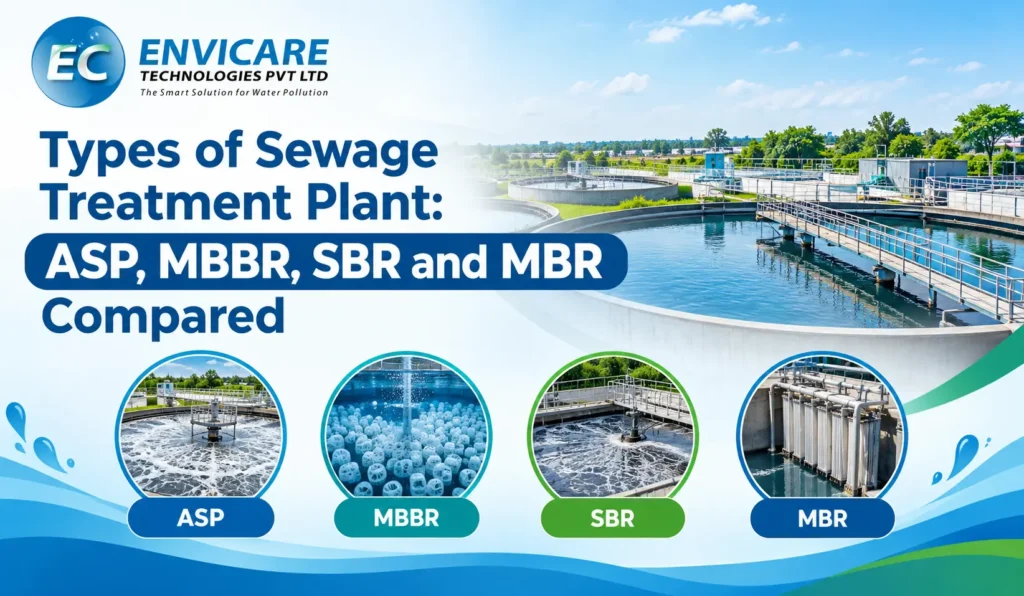
Among the commonly used types of sewage treatment plant, four technologies frequently considered for building and infrastructure projects are the Activated Sludge Process (ASP), Moving Bed Biofilm Reactor (MBBR), Sequencing Batch Reactor (SBR) and Membrane Bioreactor (MBR).
While all these systems are designed to treat sewage, each follows a distinct biological treatment process and operates according to its own set of methods and requirements. Understanding these differences helps developers, housing societies, consultants and facility managers make informed decisions when planning a new STP or upgrading an existing facility.
What Are the Different Types of Sewage Treatment Plant?
A sewage treatment plant processes wastewater generated from toilets, bathrooms, kitchens and other domestic activities.The process separates solid particles, breaks down organic waste and reduces other impurities so that the resulting water can be safely discharged or reused for appropriate applications.
A typical sewage treatment plant uses multiple stages, beginning with the removal of larger waste materials, followed by biological processing and finishing steps such as filtration or disinfection to improve the final water quality.
The exact configuration depends on the incoming sewage characteristics and the required quality of the treated water.
ASP, MBBR, SBR and MBR are different approaches to biological treatment. They use microorganisms to break down biodegradable pollutants, but the way these microorganisms are maintained and separated from the treated water varies.
India’s wastewater infrastructure includes both conventional and advanced treatment technologies. NITI Aayog’s review of the urban wastewater sector identifies ASP, SBR and MBBR among the technologies used in installed sewage treatment facilities. This reflects the importance of selecting a process suited to the project’s actual requirements rather than relying on a single standard design.
1. Activated Sludge Process (ASP)
The Activated Sludge Process is a conventional biological treatment method that uses microorganisms suspended in wastewater to break down organic pollutants. It has been used for decades in municipal and institutional sewage treatment applications.
In a typical ASP-based plant, sewage first passes through preliminary treatment units that remove larger solids and grit. The wastewater then enters an aeration tank, where air is supplied to support the growth and activity of microorganisms. These microorganisms consume biodegradable organic matter and form biological flocs.
The mixture subsequently enters a secondary settling tank. The biological solids settle at the bottom, allowing clarified water to move forward for further treatment. A portion of the settled sludge is returned to the aeration tank to maintain the required microbial population, while excess sludge is removed for appropriate handling.
Advantages of ASP
ASP is a well-established process with familiar operating principles. Spare parts and technical support are generally accessible, and experienced operators can manage the system effectively. Depending on the design and treatment targets, it can be suitable for larger sewage flows.
However, conventional ASP typically requires separate aeration and settling tanks, which can increase the overall plant footprint. Its performance also depends on maintaining suitable biological conditions, controlling sludge characteristics and preventing excessive variations in incoming sewage.
Suitable applications: Municipal sewage treatment, larger residential developments, institutional campuses and projects where sufficient space is available.
2. Moving Bed Biofilm Reactor (MBBR)
Moving Bed Biofilm Reactor technology uses small plastic carriers inside a biological treatment tank. Microorganisms grow on the surface of these carriers and form a biological film that helps break down organic pollutants.
During operation, the carriers move through the wastewater with the help of aeration or mixing. This movement brings the biofilm into contact with wastewater and supports the transfer of oxygen and pollutants required for biological treatment.
Unlike conventional ASP, where most of the treatment biomass remains suspended in the water, MBBR retains a significant portion of its biological growth on the carrier media. This arrangement can support a high concentration of active biomass within a relatively compact reactor.
MBBR technology is suitable for housing societies, commercial buildings and other facilities that require effective wastewater treatment within a restricted area. It can also help improve the performance of an existing STP when additional biological treatment is required. Based on the plant’s design and treatment goals, MBBR may operate as the main biological treatment method or work alongside other treatment technologies.
Advantages of MBBR
The technology can provide flexibility in plant design and may help improve the treatment capacity of existing tanks. Biofilm growth also makes the process less dependent on maintaining all the biomass in suspension.
However, MBBR alone may not meet all wastewater treatment requirements. The overall plant must also include properly planned screening, oxygen supply, separation of suspended solids and, where necessary, additional filtration and disinfection to achieve the desired treated-water quality.
The carrier media must also be retained inside the reactor using suitable screens.
Suitable applications: Housing societies, hotels, commercial buildings, institutional facilities and STP capacity upgrades.
3. Sequencing Batch Reactor (SBR)
The Sequencing Batch Reactor is a biological treatment process in which different treatment stages take place sequentially in the same reactor tank. Instead of continuously moving wastewater through separate aeration and settling tanks, an SBR operates according to a programmed cycle.
A typical cycle includes filling the reactor with wastewater, aerating and mixing it for biological treatment, allowing solids to settle, removing clarified treated water and preparing the tank for the next cycle. Depending on the design, additional mixing or anoxic stages may be included to support nutrient removal.
The time-based operating sequence is one of the defining characteristics of SBR technology. Automated controls regulate the treatment stages and help maintain the required operating conditions.
SBR can be useful where a project needs flexibility in biological treatment and wants to reduce the number of separate process tanks. However, the number of reactors, storage arrangements and cycle timings must be designed according to the actual wastewater flow.
Advantages of SBR
SBR can provide good treatment performance when its operating cycles are correctly designed and controlled. It can also support nitrogen removal when appropriate process stages and operating conditions are incorporated.
The main consideration is its dependence on reliable automation. Faulty decanters, incorrect cycle timings, sensor problems or inconsistent operation can affect treatment performance. Operators must understand the process and respond to alarms and operating changes.
Suitable applications: Residential societies, hotels, hospitals, commercial developments and facilities that require controlled biological treatment with varying sewage loads.
4. Membrane Bioreactor (MBR)
Membrane Bioreactor technology combines biological wastewater treatment with membrane filtration. Microorganisms break down organic pollutants in the biological reactor, while membranes separate treated water from suspended solids and much of the remaining biological material.
In conventional biological systems, a settling tank generally separates biological sludge from treated water. In an MBR system, membrane separation performs this solids-separation function, allowing the plant to maintain a high concentration of biomass while producing water with very low suspended-solids content.
This arrangement can reduce the space required for treatment and improve the consistency of solids removal. MBR is particularly relevant for sites where land is expensive or restricted and where treated wastewater needs to meet demanding reuse requirements.
However, membrane systems require careful design and maintenance. Membrane fouling, cleaning requirements, replacement costs and energy consumption must be considered during project planning. Suitable pretreatment is also important to protect the membranes from damage and excessive fouling.
Advantages of MBR
MBR can produce high-quality treated water with low turbidity and suspended solids when properly designed and operated. The process is useful where water recovery and reuse are priorities.
However, the quality of MBR effluent does not automatically make it suitable for drinking. Additional treatment and verification would be required for any potable application. Depending on the intended reuse, filtration, disinfection or other polishing stages may also be necessary.
Suitable applications: Space-constrained buildings, premium residential developments, hospitals, commercial campuses and projects with demanding non-potable water reuse requirements.
ASP vs MBBR vs SBR vs MBR: Comparison Table
The following table summarises the major differences between these four types of sewage treatment plant. The ratings are general planning guidelines; actual performance depends on plant design, sewage characteristics and operating conditions.
| Comparison factor | ASP | MBBR | SBR | MBR |
| Treatment principle | Suspended-growth biomass | Biofilm on moving carriers | Time-based biological treatment cycles | Biological treatment with membrane separation |
| Space requirement | Generally higher | Moderate to compact | Moderate to compact | Generally lowest |
| Initial investment | Often lower | Moderate | Moderate | Often higher |
| Power consumption | Moderate | Moderate | Moderate | Often higher |
| Automation requirement | Moderate | Moderate | Relatively high | High |
| Maintenance focus | Sludge and aeration control | Media retention and aeration | Cycle controls and decanter | Membrane cleaning and integrity |
| Treated water quality | Good with suitable design | Good with suitable polishing | Good to high with suitable design | Very low suspended solids; high-quality effluent |
| Common applications | Larger conventional plants | Residential and commercial facilities | Residential and commercial facilities | Space-limited and reuse-focused projects |
Note: Capital and operating costs cannot be accurately ranked for every project without a common design basis. Flow, civil construction, equipment selection, treatment targets and local operating conditions can change the comparison.
Which Sewage Treatment Technology Is Best for Your Project?
There is no single technology that is best for every building. The right selection depends on the quantity and characteristics of sewage, the available installation area, the required discharge or reuse quality and the budget available for long-term operation.
For a large project with sufficient land and a preference for conventional equipment, ASP may be a practical option. MBBR is worth evaluating where a compact biological treatment arrangement or capacity expansion is required. SBR can be appropriate where controlled treatment cycles and automation suit the operating conditions. MBR is often considered when space is severely restricted or when consistent, low-solids treated water is an important requirement.
Before finalising the technology, project owners should evaluate the following factors:
- Design capacity: Estimate average and peak sewage flows based on the building’s occupancy and water usage.
- Available space: Check the area required for tanks, equipment, access, sludge handling and future maintenance.
- Treated water requirements: Define whether the water will be discharged or reused for flushing, gardening, cooling or another approved purpose.
- Total lifecycle cost: Compare installation expenses, electricity, sludge disposal, chemicals, maintenance and equipment replacement.
- Operational capability: Consider the availability of trained operators, reliable power, automation support and service assistance.
These factors are particularly important for housing societies and commercial buildings, where the performance of the STP affects daily operations, water reuse and ongoing maintenance expenses.
Why Proper STP Design and Maintenance Matter
Selecting the correct treatment technology is only one part of a successful sewage treatment project. Even a well-established process can deliver poor results if the plant is incorrectly sized, poorly commissioned or inadequately maintained.
Incoming sewage flow may change with occupancy, working schedules, seasonal usage and water consumption patterns. A treatment plant designed without accounting for these variations may experience overloading, poor settling, odour issues or inconsistent effluent quality.
Routine monitoring should include aeration performance, sludge characteristics, equipment condition and treated water quality. Where applicable, the plant should also be monitored for parameters such as biochemical oxygen demand (BOD), chemical oxygen demand (COD), suspended solids and microbiological indicators.
The required outlet limits must be confirmed against applicable pollution control requirements and the intended reuse. Additional filtration or disinfection may be necessary before treated water can be reused safely.
For an existing plant, an engineering assessment can help determine whether the problem is related to equipment failure, poor operation, inadequate capacity or an unsuitable treatment configuration. Upgrading the existing system may be feasible in some cases, while others may require a more comprehensive redesign.
Conclusion
Understanding the types of sewage treatment plant is an important step in planning reliable wastewater management for residential, commercial and institutional buildings. ASP, MBBR, SBR and MBR each offer different advantages in terms of biological treatment, space, automation, operating costs and treated water quality.
ASP remains a well-established option for conventional applications, MBBR provides flexibility through attached-growth biology, SBR uses automated treatment cycles, and MBR combines biological treatment with membrane-based solids separation.
The final decision should be based on engineering calculations, site conditions, wastewater characteristics and the intended use of treated water—not simply on the name of the technology or its initial price.
Envicare Technologies provides water and wastewater treatment solutions, including sewage treatment plant design, installation and related services. A project-specific assessment can help identify a suitable treatment configuration for the building’s capacity, available space and water recovery objectives.