
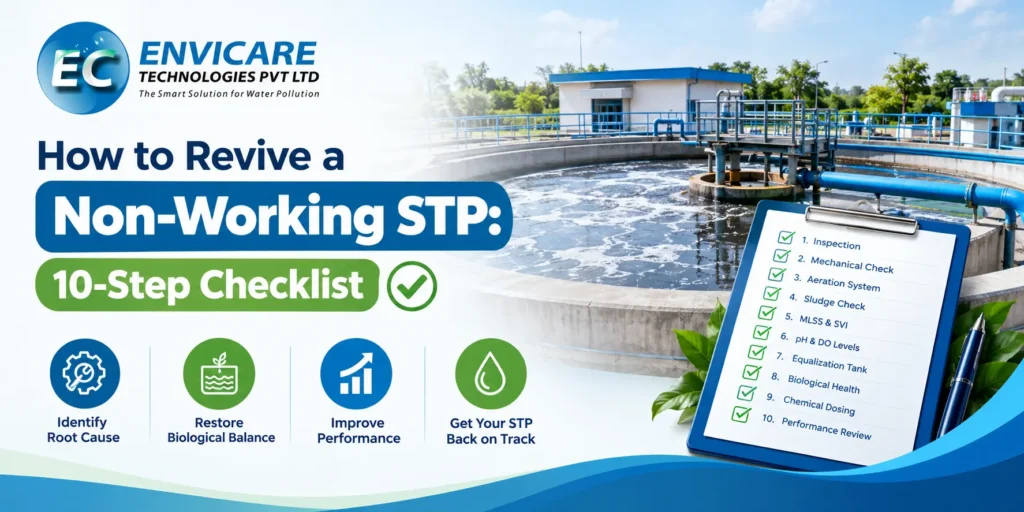
A sewage treatment plant (STP) is designed to continuously treat wastewater and produce treated water that can be safely reused or discharged as per applicable requirements. However, many residential societies, commercial buildings, hotels, hospitals and industrial facilities eventually face an STP that is not performing as expected. The plant may be producing poor-quality treated water, generating excessive odour, developing sludge problems, consuming too many chemicals or simply stopping altogether.
A non-working STP should not automatically be treated as a reason to replace the entire plant. In many cases, the underlying problem is related to poor operation, inadequate maintenance, damaged equipment, biological imbalance, incorrect chemical dosing or years of neglect. A systematic inspection can often identify the actual cause and help determine whether the plant needs repair, upgradation or complete redevelopment.
With increasing attention on wastewater management, water reuse and environmental compliance, reviving an existing STP has become an important consideration for facility owners and housing societies. Instead of immediately investing in a new system, understanding why the existing plant has failed is the first step towards a practical solution.
Why Do STPs Stop Working Properly?
An STP is not a single machine. It is a combination of mechanical equipment, electrical systems, tanks, pipelines, pumps, blowers, treatment processes and biological activity. If one important component is not functioning correctly, the performance of the entire system can decline.
For example, a blower failure can reduce oxygen availability in an aeration tank. This can affect microorganisms responsible for biological treatment and eventually result in poor BOD and COD removal. Similarly, damaged pumps can disturb flow between treatment stages, while excessive sludge accumulation can reduce the effective volume of treatment tanks.
In housing societies, another common issue is inconsistent operation. A plant may have been designed correctly but operated without regular monitoring. Operators may not record pH, dissolved oxygen, sludge levels, flow or equipment performance. Over time, small problems become major failures.
10-Step Checklist to Revive a Non-Working STP
Reviving an STP should begin with diagnosis rather than immediately replacing equipment. The following ten-step approach provides a practical framework for assessing an underperforming or shut-down treatment plant.
1. Conduct a Complete STP Health Inspection
The first step is to inspect the entire plant. The inspection should cover civil structures, mechanical equipment, electrical panels, pumps, blowers, pipelines, valves, aeration systems, sludge handling arrangements and control systems.
The condition of each treatment stage should be documented. Cracks, leakage, corrosion, blockages, damaged components and unusual sounds or vibrations should not be ignored.
A proper inspection also helps establish whether the plant is suffering from one major failure or several smaller problems occurring simultaneously.
2. Check the Incoming Sewage Flow
An STP can perform poorly when the actual sewage flow is very different from the original design conditions.
If the incoming flow is significantly higher than the design capacity, hydraulic overloading may reduce treatment efficiency. On the other hand, very low flow can also affect biological treatment because the microorganisms may not receive a consistent food load.
Flow should therefore be measured and compared with the plant’s original design capacity. Daily variations should also be considered because residential societies may experience significant differences between morning, afternoon and night-time wastewater generation.
3. Inspect Pumps, Blowers and Mechanical Equipment
Mechanical equipment is one of the most common reasons for STP failure. Pumps may become blocked, impellers may wear out and motors may develop electrical or mechanical faults. Blowers can lose efficiency because of damaged components, clogged filters or incorrect operating conditions.
The inspection should determine whether equipment needs simple servicing, replacement of spare parts or complete replacement.
It is also important to check whether equipment capacity matches current operating requirements. Replacing a failed pump with another unit of unsuitable capacity may solve the immediate problem but create another operational issue.
4. Restore Proper Aeration
Biological treatment depends heavily on maintaining appropriate aeration conditions. If the aeration tank does not receive sufficient oxygen, the microbial population responsible for wastewater treatment can become weak or unstable.
Operators should check blower operation, air pressure, air distribution and diffuser performance. Blocked or damaged diffusers can result in uneven oxygen distribution even when the blower itself is working.
Dissolved oxygen should also be monitored instead of relying only on the sound or operation of the blower. The correct operating range depends on the treatment process and plant design, so measurements should be evaluated by a qualified wastewater professional.
5. Examine the Biological Treatment Process
A plant can have fully functional pumps and blowers and still produce poor-quality water if the biological process is disturbed.
The health of the biological system depends on factors such as organic loading, oxygen availability, sludge retention, pH, temperature and operating conditions. A sudden change in wastewater characteristics or prolonged shutdown can significantly affect microbial activity.
Restarting a biological treatment system after a long period of inactivity should therefore be approached carefully. Simply switching on the equipment may not immediately restore treatment performance.
6. Check Sludge Levels and Sludge Management
Excess sludge accumulation is another frequent reason for poor STP performance. When sludge is not removed at appropriate intervals, it can occupy treatment capacity and interfere with the biological process.
Operators should assess sludge accumulation in relevant tanks and verify whether the sludge handling system is functioning correctly.
Sludge should not simply be allowed to build up because the plant appears to be treating wastewater. A treatment system requires controlled sludge management to maintain stable operation.
7. Test pH and Other Water Quality Parameters
Visual inspection alone cannot determine whether an STP is actually working.
Water samples should be tested at appropriate treatment stages and at the final outlet. Depending on the application and regulatory requirements, parameters may include pH, BOD, COD, TSS and other relevant indicators.
Testing can reveal whether the problem originates in primary treatment, biological treatment, clarification or the final treatment stage. It can also help identify whether operational changes have actually improved performance.
8. Review Chemical Dosing and Treatment Requirements
Chemical dosing should be based on the actual treatment requirement rather than guesswork. Excessive chemical usage increases operating costs, while insufficient dosing can result in poor treatment where chemicals are part of the process.
Chemical storage, dosing pumps, pipelines and injection points should be inspected. The dosing system should also be checked for blockage, calibration problems and inconsistent operation.
If the wastewater characteristics have changed since the plant was originally commissioned, the chemical treatment approach may also need reassessment.
9. Inspect Electrical and Control Systems
An STP can appear to have a mechanical problem when the actual issue is electrical.
Electrical panels, motor starters, cables, overload protection, sensors, level controls and automation systems should be inspected. Loose connections, damaged components and outdated control systems can result in repeated equipment failures.
Where automation is installed, operators should verify whether sensors and control logic are providing reliable information. A faulty level sensor or control signal can cause pumps and blowers to operate incorrectly.
10. Prepare a Revival and Upgradation Plan
After completing the inspection, the final step is to create a clear action plan.
The plant should be divided into components that require servicing, repair, replacement, modification or no action. This prevents unnecessary expenditure and makes it easier for the society or facility management team to prioritise urgent work.
A professional STP revival plan may include mechanical repairs, electrical upgrades, diffuser replacement, pump or blower replacement, sludge removal, biological process correction, pipeline modifications and improvements to monitoring systems.
The objective should not simply be to restart the plant. The objective is to restore stable performance and create an operating system that can be maintained over the long term.
STP Revival: Repair, Upgrade or Replace?
One of the biggest decisions after an STP inspection is determining whether the existing plant can be revived.
| Condition Found | Recommended Approach |
| Pumps or motors are damaged | Repair or replace equipment |
| Diffusers are clogged or damaged | Clean or replace diffusers |
| Excess sludge accumulation | Desludging and process correction |
| Electrical panel problems | Electrical repair or control upgrade |
| Biological process imbalance | Process stabilisation and monitoring |
| Capacity is insufficient | Hydraulic/process upgradation |
| Major civil damage | Structural repair or redevelopment |
| Plant is fundamentally unsuitable | Consider replacement or major redesign |
The decision should be based on the condition of the complete system rather than the failure of a single component. A plant with good civil structures and recoverable equipment may be significantly more economical to revive than to replace.
Why Regular STP Maintenance Matters
An STP should not receive attention only when treated water quality becomes unacceptable. Preventive maintenance can identify problems before they become expensive failures.
Regular inspection of pumps, blowers, electrical systems, aeration equipment, sludge levels and water quality helps facility managers understand how the plant is performing. Operator logbooks should record important operating parameters and equipment observations.
For housing societies, regular STP maintenance is particularly important because the plant is often operating every day with varying sewage loads. A breakdown can quickly create operational, environmental and management problems.
A structured Annual Maintenance Contract (AMC) can provide scheduled inspection, preventive maintenance, troubleshooting and operational support. However, the scope of an AMC should be clearly defined according to the actual condition and requirements of the STP.
What Happens If a Non-Working STP Is Ignored?
Ignoring an underperforming STP can increase both operational costs and environmental risks. Poor treatment may result in foul odour, sludge accumulation, unhealthy surroundings and poor-quality treated water.
In facilities where treated wastewater is intended for flushing, gardening or other non-potable applications, poor treatment can also reduce the reliability of water reuse. This can increase dependence on fresh water or tanker supplies.
A neglected plant can also become more expensive to restore over time because corrosion, equipment deterioration and civil damage may continue while the system remains unused.
A Practical Approach for Housing Societies
Housing societies should avoid making STP decisions based only on complaints such as “the plant is not working” or “the water is dirty.” The actual cause needs to be established through inspection and testing.
The society committee, facility manager and STP operator should maintain basic records covering sewage flow, equipment operation, maintenance activities, sludge removal and water quality testing. These records make it easier to identify recurring issues and evaluate contractor performance.
If the existing STP has been shut down for a long period, a complete technical assessment is especially important before restarting the plant. Restarting without checking the condition of pumps, blowers, tanks, pipelines and biological processes can lead to repeated failures.
When Should You Call an STP Professional?
Professional assistance is recommended when the cause of failure is unclear, treated water quality remains poor despite routine maintenance, major equipment has failed, the plant has been shut down for an extended period or the existing capacity no longer matches wastewater generation.
A professional assessment can distinguish between a simple maintenance problem and a deeper process or design issue. This can help prevent unnecessary replacement of equipment and provide a more practical repair or upgradation strategy.
Conclusion
A non-working STP does not always mean that the entire plant needs to be replaced. In many situations, the problem can be traced to equipment failure, inadequate aeration, sludge accumulation, biological imbalance, poor monitoring, electrical faults or incorrect operation.
The most effective approach is to inspect the complete system, identify the root cause and then develop a structured revival plan. The ten-step checklist—from health inspection and flow measurement to equipment assessment, biological correction, testing and final upgradation planning—provides a practical starting point.
For housing societies, commercial facilities and industrial sites, restoring an existing STP can improve wastewater treatment reliability, support water reuse and reduce the risk of prolonged plant downtime. Most importantly, the focus should shift from simply “making the STP run” to achieving stable, measurable and maintainable treatment performance.
Frequently Asked Questions
1. Can a non-working STP be repaired?
Yes. Many non-working STPs can be restored through equipment repair, process correction, desludging, electrical work, aeration improvements or other upgrades. However, the feasibility depends on the actual condition of the plant.
2. How do I know whether my STP needs repair or replacement?
A technical inspection should evaluate the civil structure, mechanical equipment, electrical system, treatment process and current capacity. If the core infrastructure is in usable condition, repair or upgradation may be more practical than complete replacement.
3. Why is my STP producing bad-smelling water?
Odour can be associated with inadequate aeration, septic conditions, sludge accumulation, poor housekeeping, excessive organic loading or other process problems. The exact cause should be identified through inspection rather than treating odour as a standalone problem.
44. How Frequently Should an STP Be Maintained?
Maintenance frequency depends on the plant design, equipment and operating conditions. Routine inspections should be carried out regularly, while preventive maintenance should follow equipment and process requirements.
5. Can an STP be restarted after being shut down for months?
It can often be restarted, but the plant should first be inspected. Tanks, pumps, blowers, electrical systems, pipelines, diffusers and biological conditions should be evaluated before normal operation is resumed.
6. Does an STP AMC prevent breakdowns?
A properly structured AMC can reduce the likelihood of unexpected breakdowns by providing preventive maintenance and regular monitoring. It cannot eliminate every failure, but it can help identify developing problems earlier.
7. What tests should be performed on treated sewage?
The testing requirements depend on the application and applicable standards. Common parameters used to evaluate STP performance include pH, BOD, COD and TSS, along with other parameters where required.
8. Is STP upgradation better than installing a new plant?
Not always, but it can be a cost-effective option when the existing civil structure and major components remain usable. A technical assessment should be completed before deciding between revival, upgradation and replacement.